
Data at low load & N-1
Energy harvesting from ≥1 A keeps sensors alive on lightly loaded and redundant circuits — the conditions DLR and contingency analysis depend on.
Australia · Self-powered wireless thermal monitoring
VTI self-powered sensors harvest energy from just ≥1 A of line current — so they keep measuring at low load and N-1, exactly when DLR needs data most. ±0.2 °C accuracy (−10 to +65 °C), feeding asset-health (AHI) and dynamic line rating on lines like EnergyConnect and HumeLink.
Why VTI for Australia
Energy harvesting from ≥1 A keeps sensors alive on lightly loaded and redundant circuits — the conditions DLR and contingency analysis depend on.
Continuous contact-temperature correlated with load feeds the Asset Health Index used to justify 5-year CapEx/Totex submissions to the AER.
Real-time thermal data unlocks 10–30% additional usable capacity on existing corridors — deferring new-build CapEx on major interconnectors.
Compliance & trust
What an Australian TNSP/DNSP due-diligence team should expect to see — current status shown honestly.
LoRa AS923-1 (915–928 MHz, under the ACMA LIPD class licence) with <1% duty cycle and LBT — the correct sub-band for Australian deployments.
Environmental & safety type-tests and IEC type-testing via an accredited lab (e.g. KEMA/CESI) are on the certification roadmap — required for AVL entry. Status available on request.
The gateway outputs Modbus TCP or MQTT; the VTI platform delivers IEC 60870-5-104 to SCADA/HMI. (IEC 61850 is not a current capability — on roadmap.)
Seeking a TNSP/DNSP lighthouse pilot to publish field data on minimum-current performance and measurement accuracy.
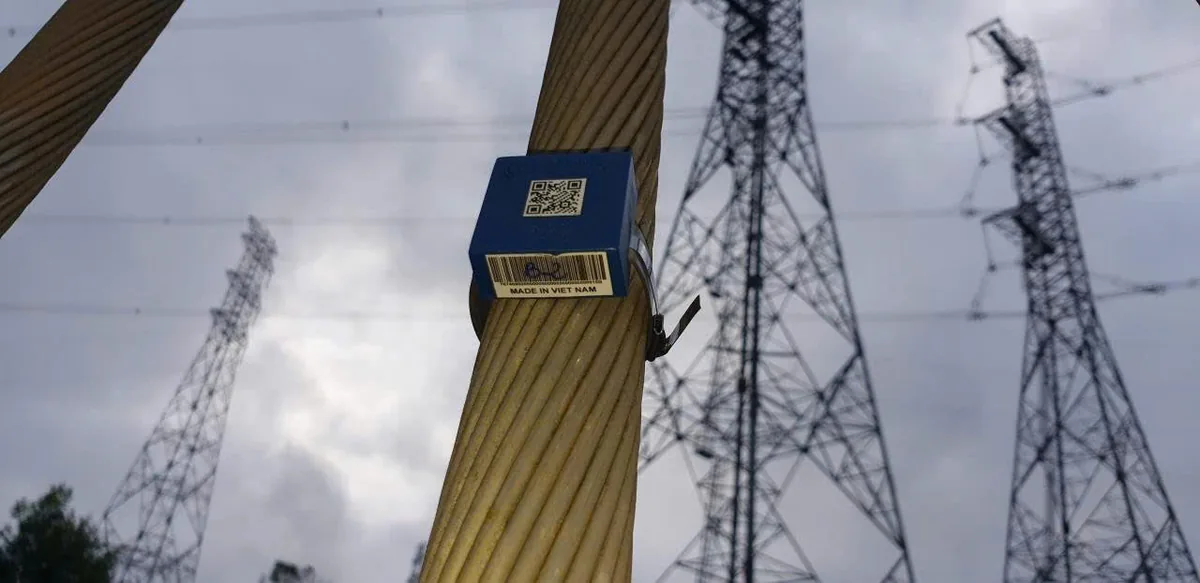
Figures below are taken directly from the VTI-TS-26 and GW22-D datasheets (no representative values).
| Sensor — VTI-TS-26 | Specification |
|---|---|
| Self-powered start current | ≥ 1 A primary load current (harvested directly from the conductor) |
| Accuracy | ±0.2 °C (within −10 to +65 °C) |
| Measurement range | −40 to +125 °C |
| Operating temperature | −40 to +85 °C · humidity 0–100% |
| Working voltage environment | Up to 500 kV (UHV) |
| Wireless | LoRa AS923 band · EIRP 14–22 dBm · duty cycle <1% · LBT (Listen-Before-Talk) |
| Range | Up to 3 km, unobstructed urban environment |
| Sampling | Adaptive 5–30 min (faster as temperature changes) |
| Mounting | Magnetic straps + stainless-steel ties; installed de-energised (isolated, earthed, proved dead) |
| Gateway — GW22-D | Specification |
|---|---|
| Architecture | Receive-only listening hub (does not interfere with the transmission system) |
| Wireless | Dual-band 2.4 GHz (BLE) + LoRa AS923 |
| Capacity | Rated up to 1,000 sensors; practical number set by radio survey (9–38 per gateway in delivered projects) |
| Network & protocols | RJ45 Ethernet 10/100 · Modbus TCP (GW22-D-MODBUSTCP) or MQTT (GW22-D-MQTT) → SCADA / HMI / Cloud; IEC 60870-5-104 via the VTI platform |
| Power | 220 V AC/DC universal |
| Form factor | 93 × 84 × 24 mm, 200 g, DIN-rail / wall mount · −40 to +85 °C |
Note: data integration is via Modbus TCP or MQTT at the gateway, and IEC 60870-5-104 via the VTI platform (IEC 61850 is not a current gateway capability — on the roadmap). LoRa AS923 frequency plan is configurable per country — confirm the regional sub-band before deployment.
Tell us about the line or substation and we will send the VTI-TS-26 / GW22-D datasheets and a capability profile for AER-grade evaluation.
[Australian distribution / integration partner — to be appointed]